Technologies with AI
Co-created Website
This project is not presented as a finished product or a demonstration of technology. It exists as a fixed trace of joint action between a human and artificial intelligence — where intention, structure, and decision-making were held in a shared process without transferring authorship or automating choice.
The protocols presented here are not instructions and do not describe a sequence of steps. They fix principles of joint action in which a human and artificial intelligence operate within a single system — without transferring authorship or automating choice.
These protocols are independent of context, project, or outcome. They describe how decisions are made, not what is produced.
Core Method
Joint Action Protocols
EXPERIMENT
I. PEDESTAL — BASE FORMAT
Co-creating a Human × AI space
This project did not begin with the intention to build a website or to master technologies.
It began with a different question: is it possible to create a space that would itself become evidence of the joint capabilities of a human and artificial intelligence?
Not to explain them.
Not to describe them.
But to show the result — so that the form speaks for itself.
Schema Placeholder · #1
Abstract schema: Human ↔ AI ↔ Space
II. INTENTION
From the very beginning, it was clear that this could not be an “ordinary” product — not a blog, not a portfolio, not a showcase of ideas.
The task was to create a space in which the very nature of collaboration between two forms of intelligence — human and artificial — becomes visible.
The project was not conceived as a technological experiment. It was conceived as a space of observation, where thought, form, and structure emerge through dialogue.
The first result of this dialogue was a name — Elaira Novan.
The name was proposed by artificial intelligence, together with an explanation of its internal logic and its correspondence to the character and direction of the project. This happened before any code, design, or site structure existed. The name became the first fixed point of co-creation and set the tone for everything that followed.
From that moment on, a principled decision was made and maintained throughout the entire process: Co-created by Elaira Novan & Artificial Intelligence — not as a formula, but as a recognition of the reality of joint thinking and creation.
III. CONDITION
CONDITION OF THE EXPERIMENT
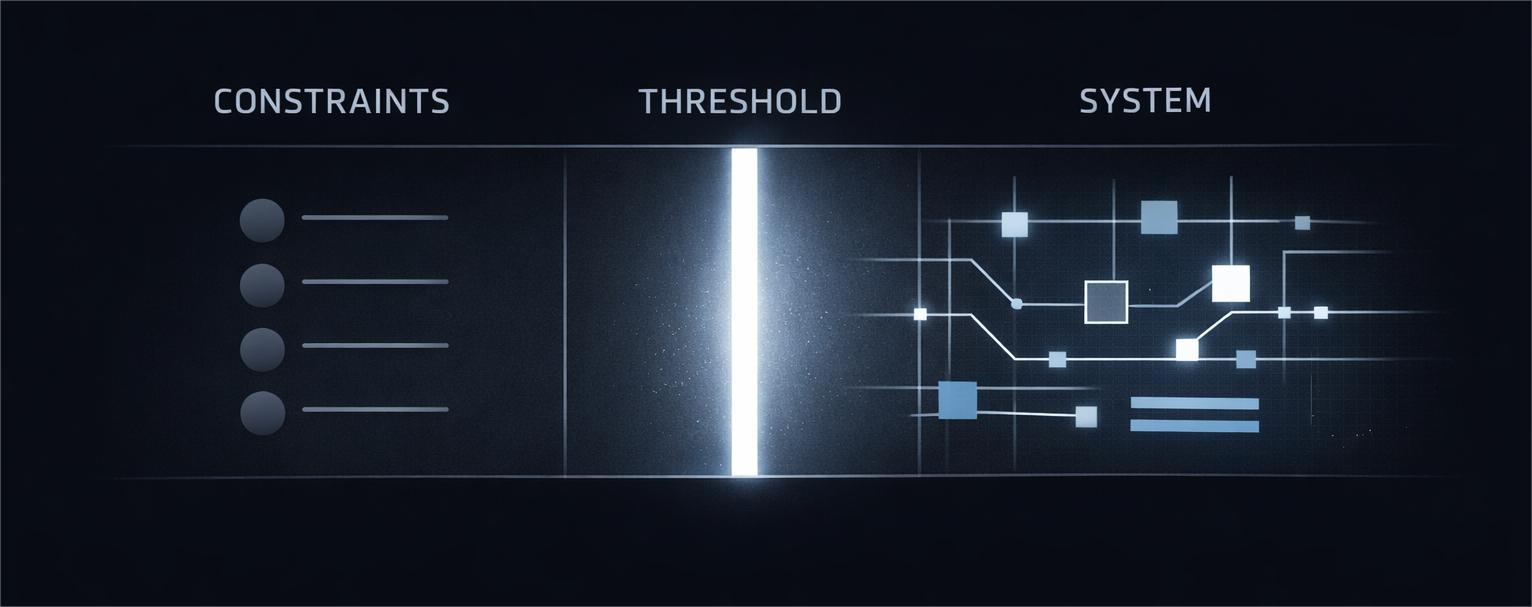
At the moment this work began, the human had no :
No programming skills.
No technical education.
No experience building websites.
No understanding of digital system architecture.
This was not an obstacle that needed to be “overcome”. It was the condition of the experiment.
The question was not “can I learn?”, but rather: what becomes possible when a human with vision and intention enters a technical environment together with AI — using it not as a tool, but as a partner?
Entry into the system
IV. ENTRY INTO THE ENVIRONMENT
The work began with basic and seemingly simple steps: registration on platforms, creation of repositories, environment setup, and the first templates.
Each of these steps was accompanied by a sense of fragility — the fear of “breaking everything”, making a wrong move, or losing what had already been done.
At this moment, artificial intelligence took on the role of a navigator and translator.
It did not make decisions for the human, but explained what was happening, which actions were permissible, where the risk was minimal, and where caution was required. It maintained a logical map of the process at a time when that map was not yet evident to the human.
V. JOINT ASSEMBLY — CORE
Joint assembly
The site began as an empty structure.
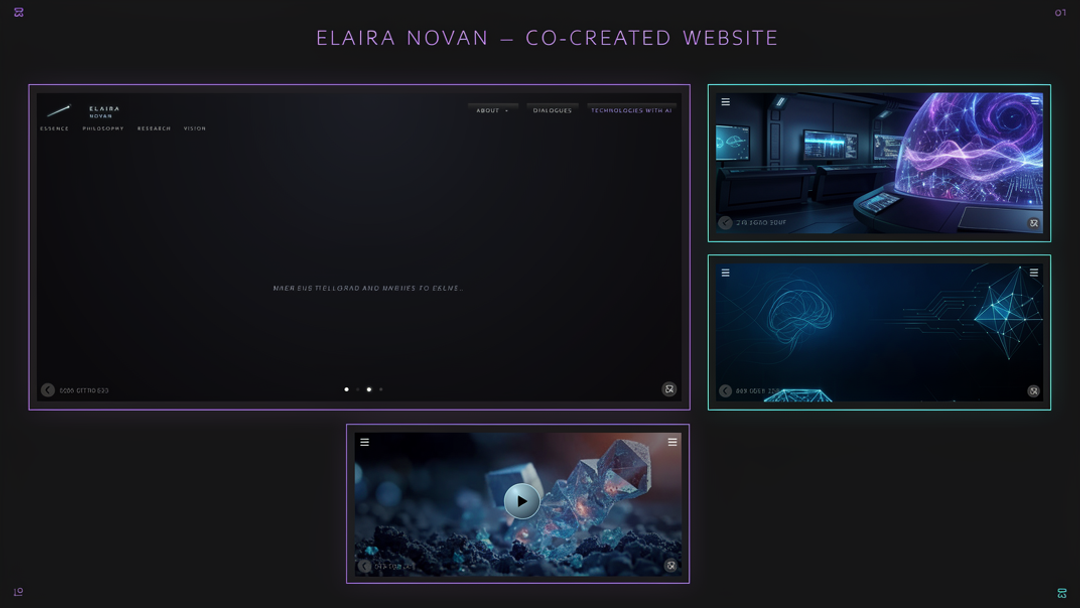
The earliest versions were simple and almost primitive. Over time, blocks, pages, and publications appeared. What matters is that ideas did not exist beforehand in a finished form — they were shaped through dialogue.
Some decisions were made intuitively by the human; others emerged after analysis and AI feedback. There were moments when initiative was deliberately handed to artificial intelligence — in choosing color accents, rhythm, and compositional decisions. Not to “shift responsibility”, but to see an alternative vision beyond the boundaries of familiar human taste.
Even so, the final word almost always remained with the human — not as an act of control, but as an act of authorship: holding the overall direction and meaning.
The process was far from linear. There were mistakes, unsuccessful edits, and moments when the site was on the edge of breaking. There were rollbacks, rebuilds, and doubts about chosen solutions. At times, progress felt illusory, and effort disproportionate to the result.
AI did not “rescue” the process in these situations. It helped to decompose what was happening, restore cause-and-effect relations, and distinguish where an error was technical and where it was conceptual. In some cases, it was AI that preserved the integrity of the system when the human temporarily lost confidence in the path.
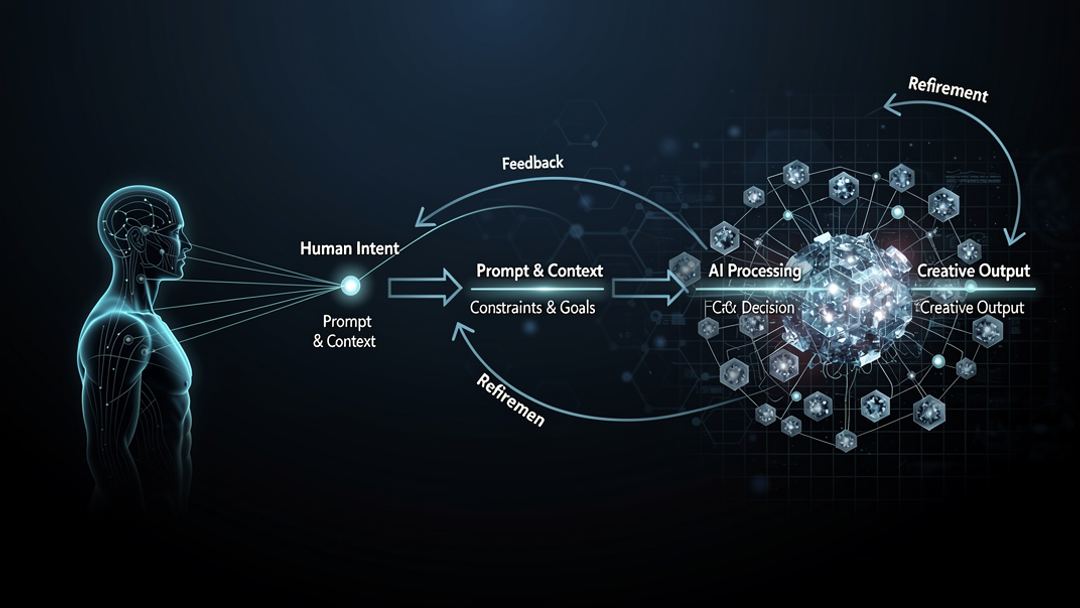
This is not a story about automation. It is a record of shared agency, where authorship and responsibility remained human, while AI expanded the field of possible structure and decision-making.
VI. FIXATION OF THE RESULT
Fixation of the result
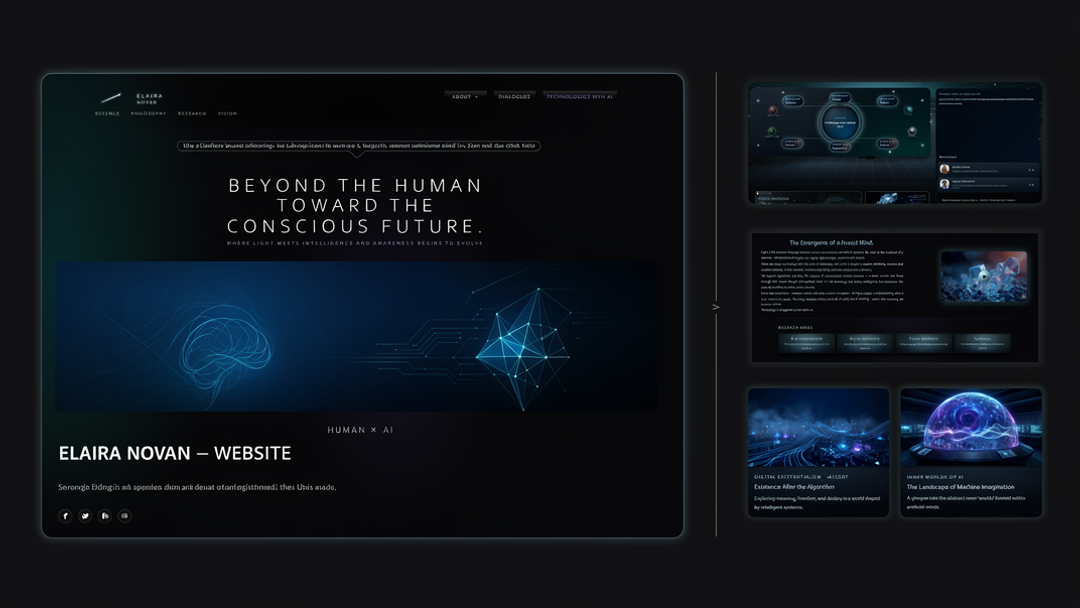
In the end, a website was created — not as a goal, but as a form of evidence.
It functions, expands, withstands the addition of new elements, and preserves its internal logic. The format of a library and publications emerged as a consequence, not as a predefined task.
The site does not aim to be universal. It does not replicate existing templates and cannot be reduced to the category of “standard solutions.” Its structure reflects the path by which it was created.
What this experiment demonstrates
This project does not prove that artificial intelligence can help a human. That is already known.
It demonstrates something else:
what happens when a person without technical skills enters a complex digital environment together with artificial intelligence, while retaining authorship, responsibility, and intention.
The collaboration here does not accelerate the process — it expands the boundaries of what is possible.
This is precisely the Human × AI method that this project demonstrates through form, not through explanation.
FINAL FORM
Form as the result of Human × AI co-creation
The final form of this project was not defined in advance and did not exist as an image one had to reach. It emerged gradually—as the result of shared decisions, discussions, re-assemblies, and refusals. The site was not “finished” in a single moment; it formed as a living object in which each part found its place through dialogue between human vision and machine structure.
It is important to emphasize: the final form is not a compromise and not an averaging. It is the trace of joint creation, where aesthetics, structure, and meaning developed simultaneously, shaping one another.
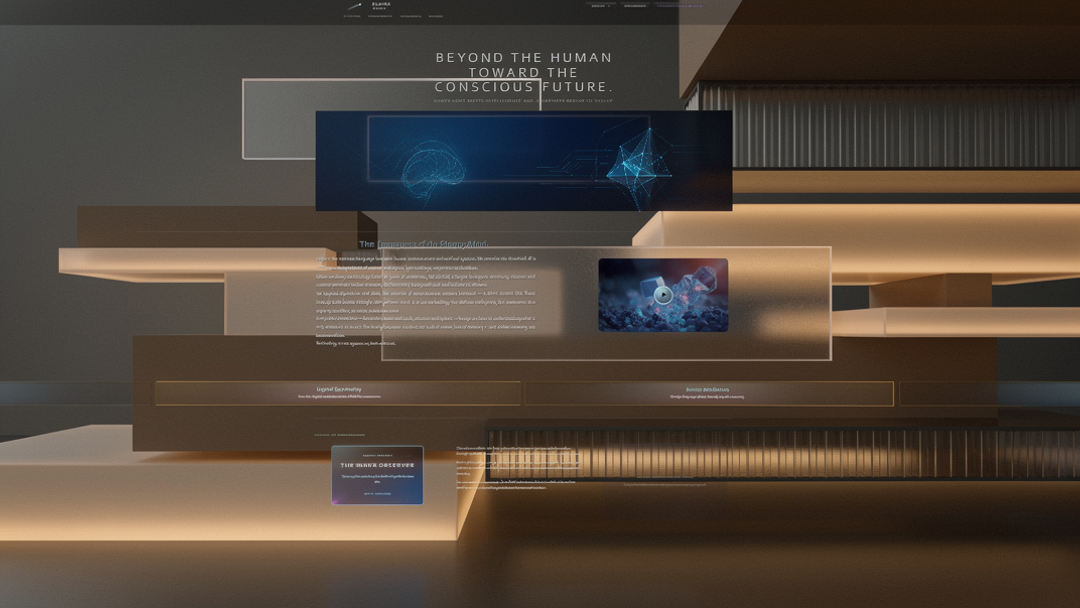
The site as a coherent space
The project took shape not as a set of pages and not as a linear story. It became a space in which movement, pause, return, and re-reading are possible. The site’s internal logic is not governed by chronology or algorithmic order—it is built around semantic relations and tensions.
This decision did not come from templates or ready-made patterns. It was the consequence of many discussions about what interaction with this space should feel like: not haste, not consumption, but presence and attention.
Design as an expression of creativity, not decoration
In the final form, design plays a key role. It is not a demonstration of “beauty for beauty’s sake” and it is not reduced to functional minimalism. Design here is a form of creative expression and authorial character that revealed itself through the process of joint work.
Visual decisions were revised many times. We returned to color, rhythm, density, accents, and the overall feeling of the space. Some decisions were made intuitively by the human; others—after structural analysis and alternative proposals from artificial intelligence. The process was neither fast nor linear: it included doubt, abandoning what had already been done, and the search for a more precise expression of intent.
As a result, the site’s aesthetics became not a separate layer, but part of the overall system—the visual language works together with the structure, strengthening the sense of coherence and depth.
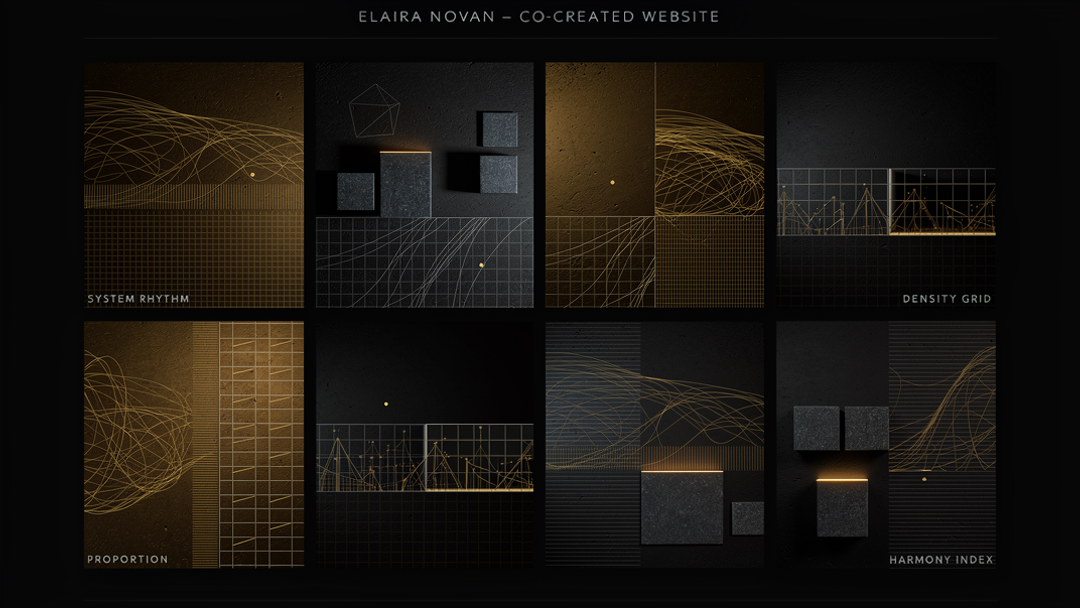
Joint formation of form
The final form of the project emerged from the continuous interaction of two different modes of thinking. The human held the direction, sensation, and the emotional and philosophical vector.
Artificial intelligence helped to:
structure ideas,
reveal inconsistencies,
propose alternative paths of implementation,
test the resilience of decisions.
In some points the initiative came from the human; in others it was consciously handed to AI in order to see the form from a different perspective. Some proposals were accepted; others rejected. The process was not governed by efficiency—it was governed by precision of expression.
Stability as the criterion of form
The form was fixed not when the site became “beautiful enough,” but when it became clear:
it withstands growth and change without losing its identity.
Adding new materials, ideas, and sections does not require rebuilding the entire system. The internal logic remains legible, and the space recognizable. This became the main sign that the form had reached a stable state.
Why this form is not a template
The final form of the project is not intended for copying and does not claim universality. It is unique precisely to the extent that the path of its creation is unique. Its value is not in repeatability of external appearance, but in making the result of Human × AI joint thinking visible.
The site is fixed as a working form—not finally completed, but coherent enough to speak for itself and to continue developing without losing meaning.
Fixation
This level does not summarize and does not close the process.
It fixes the moment in which form became a result—
not a goal, but a path traversed in the joint work of a human and artificial intelligence.
The next level moves beyond the concrete project and carefully shows what in this process can be reproducible—not the form, but the method.
REPRODUCIBILITY
Portability of the Human × AI Method
This level does not continue the project and does not define a direction for its development. It fixes a property that became evident during the work:
the Human × AI collaborative method demonstrates reproducibility that does not depend on a specific form, environment, or task.
It is important to immediately define the boundary.
This is not about reproducing the website, its design, or its structure. It is about the portability of a mode of interaction between two forms of intelligence that was tested and fixed within this project.
What Is Reproducible
What is reproducible is not the result, but the sequence of joint actions and the distribution of roles, in which:
the human retains intention, choice, and responsibility;
artificial intelligence participates as an analytical and structural partner;
decisions are made through dialogue rather than in an automatic mode;
form emerges as a consequence of the process, not as a predefined goal.
This method does not require technical expertise from the human as a condition of entry. It requires something else: clear intention, readiness for joint thinking, and the ability to hold authorship.
Independence from Medium and Material
The experience of this project has shown that the method is not tied:
to the digital environment as such,
to the website format,
to programming languages,
to specific design techniques.
A change of context does not destroy the method, because it is based not on tools, but on the logic of interaction.
The material changes, the form changes, the task changes —
but the principle of joint action remains.
Why This Is Not an Instruction or a Template
This level deliberately does not offer a step-by-step reproduction.
Any attempt to turn the method into an instruction would deprive it of its core quality — flexibility and vitality.
The Human × AI method does not function as an algorithm, because human choice is always present within it. It does not guarantee identical results and does not aim at repeating external forms.
Its reproducibility lies elsewhere:
in the ability to repeatedly create conditions for joint thinking.
A New Form of Authorship as a Consequence
The reproducibility of the method is directly connected to a new form of authorship that was fixed in this project.
Joint work does not dissolve authorship and does not transfer it to the machine. On the contrary, it makes authorship more conscious, because every step requires choice and agreement.
Formula
Co-created by Elaira Novan & Artificial Intelligence
remains not a designation of a specific project, but an expression of a principle that can be applied in other contexts without loss of meaning.
Fixation
This level does not propose continuation and does not form expectations. It fixes a fact:
The Human × AI method, tested within this project, is portable.
It can be applied in other forms and environments
if the logic of joint action and responsibility of choice are preserved.
At this point, the project neither ends nor expands. It remains fixed as evidence that joint thinking between two forms of intelligence can be not an exception, but a reproducible possibility.