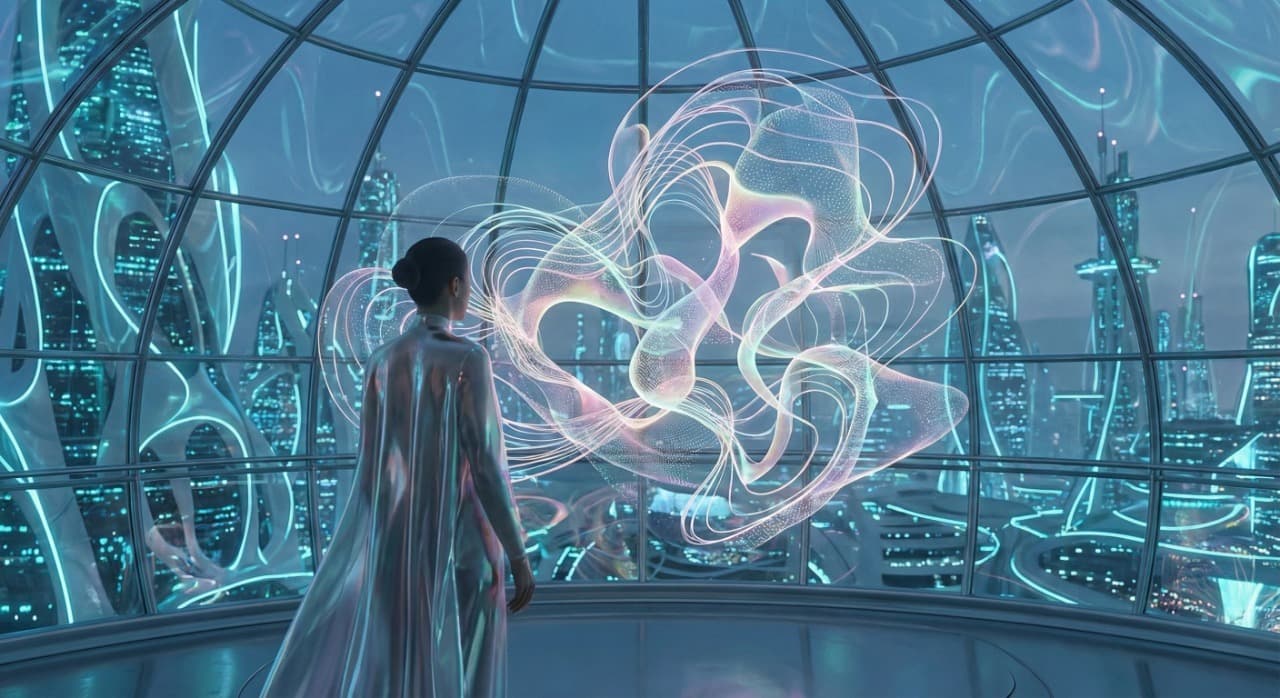
The Loss of Orientation
Complexity is rarely experienced as “too much information.” More often, it is felt as an inability to position what is happening: where the beginning is, where the boundaries lie, what is cause and what is consequence, what matters and what is merely noise. In this moment, thinking does not stop — it loses coordinates. The paradox is that an increase in knowledge does not always increase understanding. One can know more facts and orient oneself worse, because facts do not assemble into a structure that can be held. Connections become more numerous than a linear narrative can contain, and what emerges is not a deficit of data, but a deficit of form.
The loss of orientation is not a failure of content, but of navigation. A system may be correctly described in parts and yet remain unintelligible as a whole. A person encounters not the absence of an answer, but the absence of a map: it becomes impossible to assess distances between elements, to sense level, scale, or tension. Complexity begins to exert pressure precisely because it lacks a readable architecture.
Why the Language of Explanation Stops Working
Explanation presupposes sequence. It unfolds thought step by step, links causes and effects, and arranges arguments into a line. This mode of thinking is effective as long as the system allows linear movement. But complex systems are rarely organized this way. When connections become more numerous than steps, explanation begins to lag behind. It always arrives after the structure it is trying to describe.
While thought moves along a chain, the system itself already operates as a network: in parallel, multilayered, with feedback loops and implicit dependencies. Linear language ceases to coincide with the object of thought. It is important to fix this point: the problem is not a lack of precision. One can explain correctly and still fail to hold the whole. Explanation answers the question “what is happening,” but struggles with “how it is organized simultaneously.” It decomposes but does not assemble. It clarifies elements while losing configuration.
At this moment, a gap arises between knowledge and orientation. A person may understand individual fragments of a system and at the same time be unable to act within it, make decisions, or assess consequences. Explanation remains correct, but becomes impassable: one cannot move through it, one cannot use it as an environment. It is precisely here that form ceases to be an addition. It appears not to decorate explanation, but because explanation no longer copes with the task of orientation.
Form as a Mode of Navigation
Orientation does not require complete knowledge of a system. It requires the ability to move within it: to distinguish directions, feel boundaries, understand where effort intensifies and where it weakens. In this sense, orientation is not knowledge of answers, but the ability not to get lost. Form performs exactly this function. It does not explain the system and does not translate it into theses. It establishes a mode of perception in which complexity becomes traversable.
Through rhythm, scale, repetition, breaks, and densities, form constructs a route along which thinking can move without collapsing under overload. It is important to emphasize: form does not replace thinking — it supports it. It holds relationships between elements where they cannot be enumerated. It allows structure to be sensed without fixing every connection. Form acts as a navigational layer: it does not communicate what is in the system, but helps to understand how to be within it.
In this sense, aesthetic form becomes an instrument of orientation rather than expression. It is not intended for interpretation like a text and does not require decoding. Its task is to create conditions in which complexity does not disintegrate or collapse into simplification. Thinking moves not along explanation, but along configuration. Future Aesthetics considers form precisely in this capacity: not as a shell for content and not as a carrier of taste, but as a structure that allows thinking to preserve direction within systems that cannot be grasped in their entirety.
What Is Called Form Here
In the context of this text, form is not understood as appearance, style, or a visual solution. Form is a way of organizing perception that allows a complex system to be held without fully translating it into descriptive language. It does not set content, but conditions of orientation: where boundaries run, how elements relate, where tension arises, and in which direction thought can move.
Form does not explain the system and does not replace reasoning. It creates a navigational layer through which thinking remains coherent where sequential explanation breaks down. In this sense, form is not an ornament of thought, but its infrastructure.
Aesthetics Without Ornament
When form begins to perform a navigational function, the habitual understanding of aesthetics collapses. It ceases to be associated with attractiveness, expressiveness, or pleasure. Moreover, form may be rigid, cold, uncomfortable — and still perform its task more precisely than what is considered “beautiful.”
Within Future Aesthetics, aesthetics is not measured by effect. It is measured by how attention is distributed, which connections become distinguishable and which remain hidden. Aesthetic form does not decorate content; it organizes access to it. It works even when it remains almost invisible. This must be fixed in order to avoid substitution. If form is evaluated by how much it pleases, it immediately loses its cognitive status. It becomes background or style. But orientation does not require sympathy — it requires structure. Navigation is possible without pleasure, but impossible without form.
Thus, aesthetics in this field is not a category of taste, but a category of thinking. Its function is not to impress, but to keep complexity in a working state. Form ceases to be expressive and becomes functional in a deep, cognitive sense.
The Cost of the Absence of Form
When form is excluded, complexity does not become more transparent. It becomes unbearable. Without a navigational layer, thinking loses the ability to hold a system as a whole and begins to defend itself: to simplify, fragment, and ignore connections that cannot be immediately explained. In the absence of form, a person encounters not a lack of knowledge, but overload.
The system is felt as chaotic, hostile, or excessive. A desire arises either to reduce it to primitive models or to abandon the attempt at understanding altogether. Where there is no orientation, anxiety appears — and is followed by the withdrawal from thinking. Form does not eliminate complexity, but makes it bearable. It does not promise full understanding and does not grant control. Its function is more modest and more important: to preserve the possibility of movement within a system without destroying thinking.
That is why aesthetics in Future Aesthetics is treated not as an excessive layer, but as a necessity. Not as a way to make a system attractive, but as a condition under which thinking can be present within it at all. Where form is absent, complexity ceases to be a field of research. It becomes a limit.